


The short answer
Research suggests that certain design features common in social media, like public like counts, unpredictable notifications and beauty filters, may contribute to anxiety in some children and teens. The science is still developing, and not every child is affected the same way. But if you've noticed your kid seems edgier after a long scroll session, or melts down when you take the phone away, you're far from alone. A growing number of researchers, parents and now courts are asking the same questions you are.
{{messenger-inline-cta-1}}
What is the screen time meltdown?
If you've ever taken your child's phone away and braced yourself for impact, you know the feeling. What starts as a reasonable boundary (it's dinnertime, screens away) can turn into a full-blown standoff in seconds. Tears, slammed doors, accusations that you're ruining their life. Or maybe it's subtler. Your kid comes downstairs after an hour on their phone and just seems off. Irritable. Deflated. Like they went somewhere and came back slightly different.
A lot of parents are noticing this. For a long time, the answer they got was "kids these days" or "set firmer limits." But courts and researchers are increasingly pointing to something else: the apps themselves. A recent landmark lawsuit found Meta and Google liable for harm to a minor, not because of the content on the platforms, but because of the design decisions behind them. Social media bans for kids under 16 are now in place in Australia and rolling out elsewhere around the world. The question has shifted from how much screen time to what is that screen time actually doing?
What the screen anxiety loop might be
There are actually two different mechanisms worth understanding here, and your kid may be experiencing one, the other or both.
The first is about posting. Many social apps are built around what behavioural researchers call a variable reward loop, the same mechanism that makes slot machines hard to walk away from. You post something, then wait. Will it get likes? Will anyone comment? The uncertainty is the point. For kids whose social lives are playing out on these platforms, every post can feel like a small test. Every notification, or absence of one, is feedback on whether they're liked, whether they fit in, whether they matter.
The second is about watching. Even kids who never post are scrolling through carefully curated, filtered, algorithmically selected highlights of other people's lives. Researchers call this social comparison, and social apps are specifically designed to maximise it. Beauty filters set a standard that doesn't exist in the real world. Algorithmic feeds prioritise content that provokes a strong reaction, which often means content that makes kids feel behind, left out or not enough. A child can absorb hours of this without ever posting a single thing.
Researchers are still working out the exact relationship between these features and anxiety. Correlation isn't causation, and individual experiences vary. But enough parents are seeing enough things at home that it's worth understanding what's going on.
What are manipulative design features?
- Public like counts and follower numbers. Social acceptance becomes something that can be scored and compared in real time.
- Notification timing. Some platforms deliberately delay notifications to create anticipation and drive re-engagement. The side effect may be a constant background hum of waiting.
- Beauty filters and social comparison. Kids are comparing their unfiltered selves to filtered versions of everyone else. The KGM lawsuit specifically cited beauty filters as a factor in the teen's body dysmorphia.
- Infinite scroll and autoplay. These remove natural stopping points, so the decision to stop has to be made actively, over and over, which is a lot to ask of a developing brain.
Stepping away from these apps requires an active decision, made repeatedly, against a design engineered to prevent it. The meltdown at dinner, the edginess after a long scroll, these may be connected to the design of the apps themselves.
What some families are trying
- Name the features together. Walk through the design mechanics with your kid as a shared investigation, not a lecture. Understanding that notifications are sometimes delayed on purpose can make the experience feel less personal.
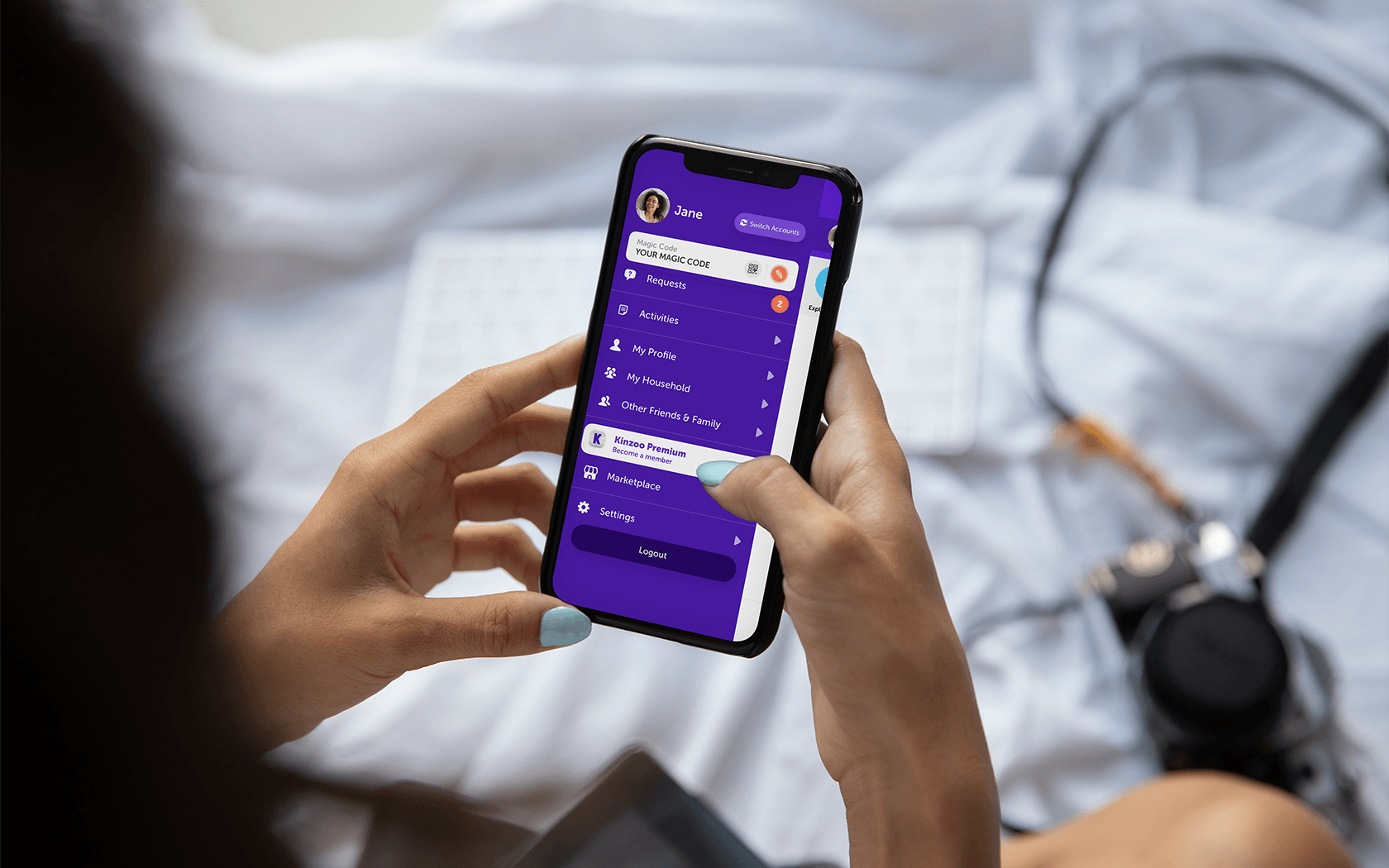
- Choose platforms with different values. Not all apps are built the same way. Some kids' platforms are designed without public metrics, algorithmic feeds or comparison architecture.
- Build in natural stopping points. Since the apps remove them by design, creating external ones, like a set time, a shared activity that follows, can make transitions easier.
- Keep the conversation open. Kids who feel they can talk about what they're experiencing online tend to share more. Which means you hear about problems earlier.
Try out a safer social experience for your kids and download Kinzoo Messenger today.
FAQs
Can social media cause anxiety in kids?
Possibly, and researchers are taking it seriously. The science is still developing, but the link between certain design features and anxiety is significant enough that courts and regulators are now paying attention.
Why does my child have a meltdown when I take away their phone?
It may be less about attitude and more about design. Apps are built without natural stopping points, so stopping requires an active decision made against a system engineered to prevent it. That's genuinely hard, especially for developing brains.
Why does my child seem edgy after using social media?
What we do know is that social apps are designed to be emotionally engaging, through social comparison, feedback loops and algorithmically served content that provokes strong reactions. It's plausible that sustained exposure to that kind of stimulation has a carry-over effect, though the research on exactly what's happening and why is still developing.
What design features should I know about?
The main ones: infinite scroll, algorithmic feeds, public like counts, delayed notifications, beauty filters and autoplay. None of these were accidents, they were deliberate design decisions.
Sources: Pew Research Center, "Teens, Social Media and Mental Health" (2025); Nagata et al., "Social Media Use and Depressive Symptoms in Preteens," (2025); Shen et al., "Social Networking Site Use, Depressive and Anxiety Symptoms in Adolescents," (2026); Yang et al., "Social Media Activities With Different Content Characteristics and Adolescent Mental Health: Cross-Sectional Survey Study," (2025)
Image credit: Marco_Piunti / Getty Images